01
Identify
Recognise the trigger.
What situation repeatedly activates the response? What changes internally when it becomes uncomfortable?

Inner Architecture
Reprogramming™
Free 90-minute live masterclass
You can be capable, successful and self-aware—yet when life becomes emotionally uncomfortable, an old internal pattern can take over before conscious choice does.
The behaviour is visible.
The pattern underneath it is where the real work begins.
90-Minute Live Pattern-Breaking Masterclass · Free · Limited Seats
Recognition
You may be doing well in most areas of life. You handle responsibility. You solve problems. People trust your judgment. You know how to get things done.
And yet there may be certain situations where something changes.
“Why am I doing this again?”
Beneath the event
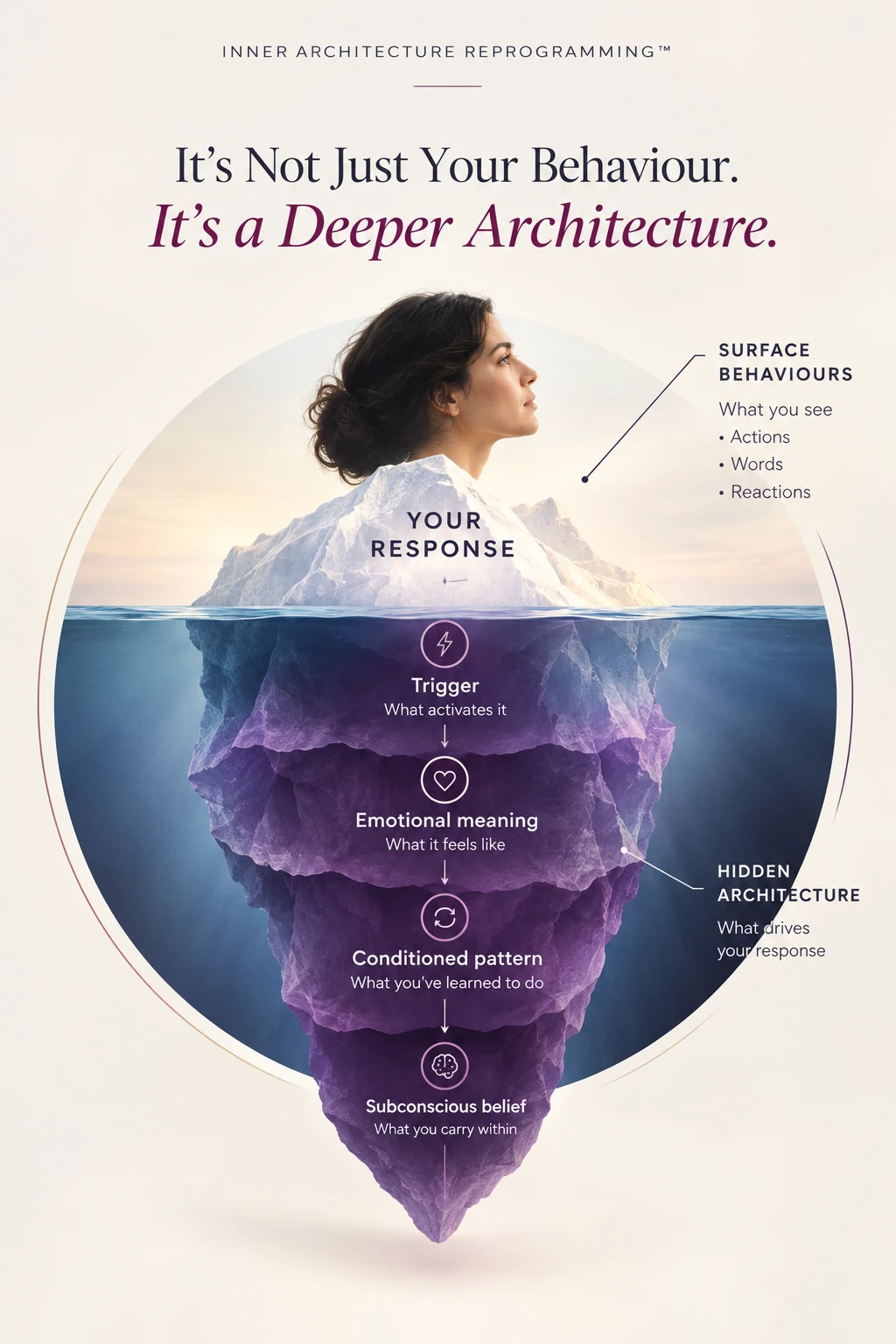
Two people can experience the same situation and respond completely differently. Because the conscious event is only one part of the process.
A situation can activate an emotional association formed much earlier. Suddenly, the present is being handled through an old pattern.
The situation may be new. The internal response may not be.
The pattern loop
Next similar situation
The loop begins again.
Changing visible behaviour can work for a while. But when emotional discomfort rises again, the old architecture can take over.
IAR works deeper than behaviour management.
Different layer. Different work.
This is not about saying conventional tools are useless. It is about recognising that different problems can exist at different layers.
Surface-level approaches may focus on
IAR explores
If the visible behaviour is being generated by a deeper conditioned pattern, changing the behaviour alone may not address what keeps recreating it.
The methodology
IAR is a framework for examining the internal architecture beneath repeated automatic responses. Instead of asking only, “What should I do differently?” we ask, “What is being activated inside me—and what meaning is driving this response?”
01
Recognise the trigger.
What situation repeatedly activates the response? What changes internally when it becomes uncomfortable?
02
Trace the emotional association.
What meaning does the situation carry? What emotion, expectation or internal rule becomes activated?
03
Break the automatic pattern.
Bring the conditioned response into conscious awareness and interrupt the loop that keeps reproducing it.
04
Build a different internal response.
Reinforce new beliefs and create greater capacity for conscious choice, self-reliance and self-governance.
From automatic response conscious response.
What changes
It is to become less governed by patterns you didn't consciously choose.
More conscious decisions
Greater emotional discernment
Less automatic reaction
Greater self-reliance
Stronger internal authority
More deliberate action
The aim is not dependence on another technique. It is developing the ability to recognise your own pattern and govern your response.
A precise fit
You are capable—but there is one area where you keep getting stuck.
You understand yourself intellectually, but your reactions don't always follow your understanding.
You have changed circumstances, but some internal patterns seem to travel with you.
You keep asking yourself, “Why am I doing this again?”
You want to understand the architecture beneath your behaviour—not collect another temporary technique.
You want greater self-governance rather than lifelong dependence on external guidance.
Suitable for working professionals, consultants, educators, entrepreneurs, leaders and anyone serious about understanding their own behavioural patterns.
The live experience
Part 1
Understand why capable people can respond automatically when emotional discomfort is activated.
Part 2
Learn how triggers, emotional associations and conditioned patterns can shape present responses.
Part 3
Bring one repeating situation and begin examining what may be operating underneath the visible behaviour.
“I know what I should do.”
“So why can't I seem to do it when it matters emotionally?”
Because knowing something consciously and being free from an old conditioned response are not necessarily the same thing.

Sunita Singh
Creator of Inner Architecture Reprogramming™
About Sunita
I have spent more than 10 years studying human behaviour, emotional patterns, psychology, Vedic thought and the deeper structures that influence how people think, feel and respond.
Author · Researcher · Emotional Alignment Coach
Author of
Threes in Everything
A Journey from Material to Transcendence
Going Within
A Rhythmic Journey in the Varied Forms of Love
My work brings together observation, rational inquiry, psychology, Vedic perspectives and a structured exploration of subconscious patterns.
Self-reliance
The deeper purpose of this work is not to give you another person to rely on for answers. It is to help you observe yourself, recognise your patterns, understand what activates them and make more conscious choices.
Questions
Your next step
You can be highly capable and still have a response that feels strangely outside your conscious control.
You can know better and still repeat.
You can change your circumstances and still carry the same internal pattern into the next one.
The first step is not judging the behaviour.
It is understanding what is underneath it.
Bring one situation that keeps repeating.
Let's look underneath the behaviour.